



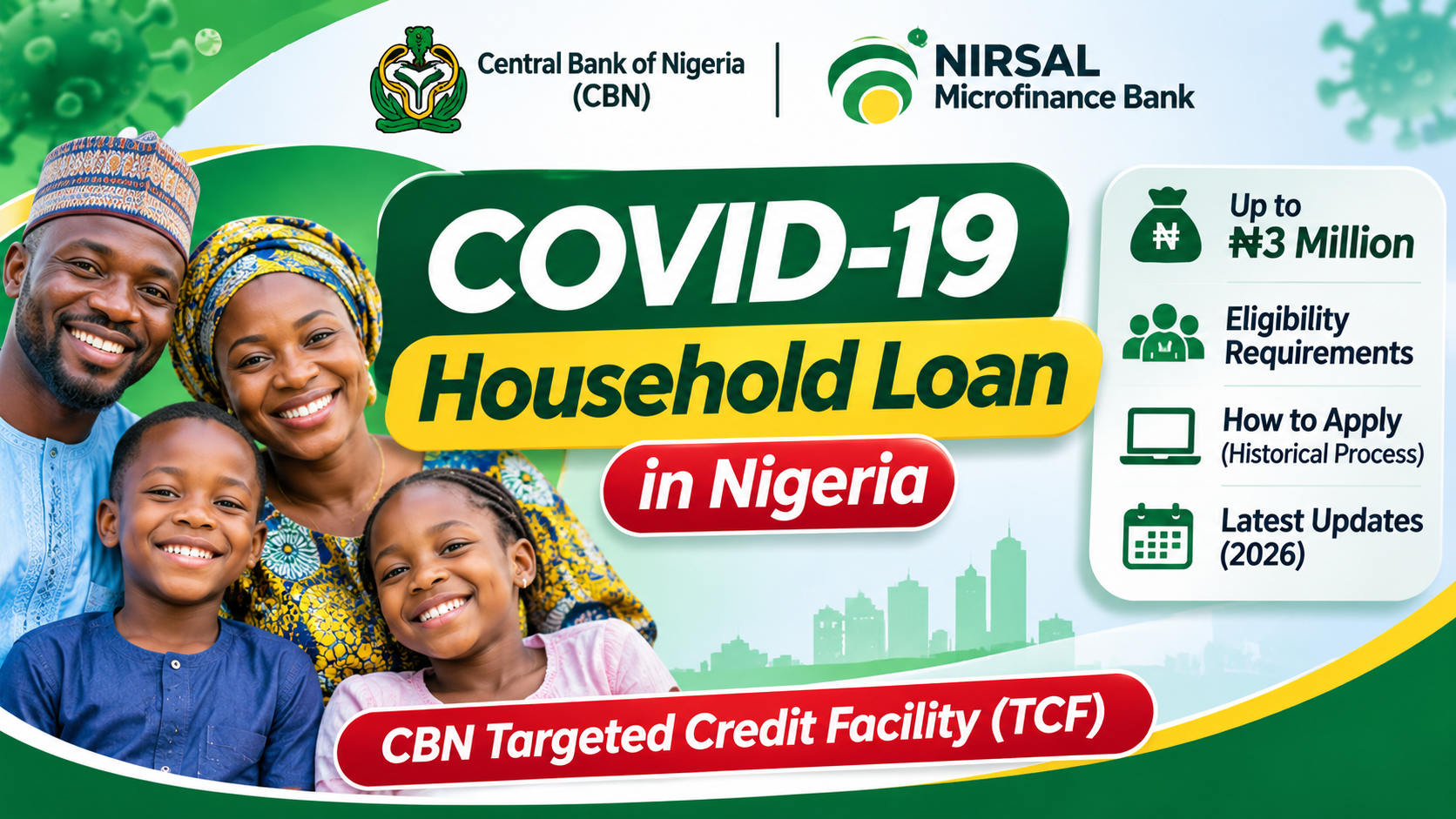
The COVID-19 Household Loan was introduced by the Central Bank of Nigeria (CBN) in 2020 to provide financial assistance to households whose livelihoods were affected by the coronavirus pandemic. The intervention formed part of the ₦50 billion Targeted Credit Facility (TCF), which was administered through NIRSAL Microfinance Bank (NMFB).
Under the programme, eligible households could access loans of up to ₦3 million, depending on their financial circumstances and the assessment of their applications. The facility was designed to help individuals and families whose income and economic activities had been disrupted by the pandemic.
Although many Nigerians still search for the COVID-19 Household Loan application portal, eligibility requirements and approval updates in 2026, it is important to understand that the original scheme had an exit date of December 31, 2024.
This guide explains how the COVID-19 Household Loan worked, who qualified, how much applicants could receive, the original interest rate, how to check existing application information and what borrowers should know about repayment.
What Is the COVID-19 Household Loan?
The COVID-19 Household Loan was part of the Central Bank of Nigeria's Targeted Credit Facility, introduced in March 2020 as an economic intervention to support households and businesses affected by the coronavirus pandemic.
The programme was established to cushion the financial impact of COVID-19, particularly for Nigerians who experienced reduced income, job losses, business interruptions and other economic difficulties during the pandemic.
NIRSAL Microfinance Bank was appointed as the participating financial institution responsible for receiving applications, conducting assessments and disbursing approved loans.
The programme had two major categories:
Household loans for individuals and families whose livelihoods were adversely affected by COVID-19.
SME loans for businesses that experienced financial difficulties or had viable opportunities arising from the pandemic.
The household component was intended to provide financial assistance for personal and household needs, while the SME component supported business activities.
Unlike a grant, the COVID-19 Household Loan was repayable. Beneficiaries were required to repay the principal and applicable interest according to their loan agreements.
How Much Was the COVID-19 Household Loan?
Under the original CBN guidelines, eligible households could access a maximum loan amount of ₦3 million.
However, ₦3 million was the maximum available limit, not a guaranteed payment for every applicant.
The amount approved depended on the applicant's circumstances, the information submitted and the assessment conducted by NIRSAL Microfinance Bank.
The original programme structure included:
| Programme detail | Information |
|---|---|
| Programme name | Targeted Credit Facility |
| Household loan limit | Up to ₦3 million |
| Total intervention fund | ₦50 billion |
| Managing institution | NIRSAL Microfinance Bank |
| Introducing institution | Central Bank of Nigeria |
| Launch date | March 2020 |
| Original interest rate | 5% per annum until February 28, 2021 |
| Subsequent interest rate | 9% per annum from March 1, 2021 |
| Repayment | Required |
| Programme exit date | December 31, 2024 |
These terms are based on the original CBN guidelines. Individual beneficiaries should refer to their signed loan agreements for the actual approved amount, interest calculations and repayment obligations.
Who Was Eligible for the COVID-19 Household Loan?
The CBN designed the household component for individuals and families with verifiable evidence that their livelihoods had been adversely affected by the COVID-19 pandemic.
This meant that applicants needed to demonstrate how the pandemic had affected their ability to earn an income or maintain their household activities.
Examples of potentially affected households included:
Individuals who lost their jobs during the pandemic.
Self-employed Nigerians whose income declined.
Households whose businesses were forced to close.
Workers who experienced significant salary reductions.
Families whose regular sources of income were disrupted.
Individuals who needed financial support to establish a new income-generating activity.
The programme also required applicants to provide relevant personal and financial information for verification.
Having financial difficulties alone did not automatically qualify someone for the facility. Applicants had to meet the programme's requirements and pass the assessment process.
What Were the Requirements for the COVID-19 Household Loan?
The original Targeted Credit Facility guidelines required applicants to provide information that would help NIRSAL Microfinance Bank verify their identity and assess their circumstances.
The requirements included:
| Requirement | Purpose |
|---|---|
| Bank Verification Number (BVN) | Identity verification |
| Personal information | Applicant identification |
| Evidence of livelihood impact | Demonstrate the effect of COVID-19 |
| Bank account details | Loan disbursement and repayment |
| Relevant supporting information | Application assessment |
The application process was conducted through NIRSAL Microfinance Bank's dedicated COVID-19 loan portal.
The bank was responsible for validating applicants' information and conducting due diligence before forwarding qualified applications to the CBN for final approval.
How to Apply for the COVID-19 Household Loan
During the original application period, Nigerians could apply through the NIRSAL Microfinance Bank COVID-19 Targeted Credit Facility portal.
The historical application process involved the following steps.
Step 1: Visit the NIRSAL COVID-19 loan portal
Applicants were directed to the dedicated NIRSAL Microfinance Bank portal:
Step 2: Select the Household loan category
The portal provided separate categories for household and SME applications.
Individuals applying for personal and household assistance selected the Household option.
Step 3: Enter your BVN
Applicants provided their Bank Verification Number to begin the identity verification process.
Step 4: Complete the application
Applicants supplied the required personal information and details explaining how their livelihoods had been affected by COVID-19.
Step 5: Submit the application
After completing the required information, applicants submitted their applications for assessment by NIRSAL Microfinance Bank.
Step 6: Wait for assessment and approval
NIRSAL Microfinance Bank reviewed applications and conducted due diligence.
Applications that satisfied the requirements were forwarded to the Central Bank of Nigeria for final approval.
Step 7: Accept the loan offer
Successful applicants received loan offer information and were required to provide the necessary banking details and accept the applicable loan terms.
Important 2026 update: The original TCF programme had an official exit date of December 31, 2024. The steps above explain the historical application process. They should not be interpreted as confirmation that new household loan applications are currently being accepted.
Is the COVID-19 Household Loan Application Still Open in 2026?
The original COVID-19 Targeted Credit Facility had an exit date of December 31, 2024, according to the CBN's implementation guidelines.
Therefore, Nigerians should not assume that the original COVID-19 Household Loan is open for new applications in November 2026.
The dedicated NIRSAL COVID-19 portal may still be accessible for certain beneficiary information and historical records. However, the continued availability of a website does not mean that the original programme has reopened.
If you previously applied, you may use the dedicated portal to investigate your existing application or beneficiary information where the relevant service remains available.
For new financing opportunities, consult NIRSAL Microfinance Bank's current loan products rather than relying on old COVID-19 registration announcements.
Official NIRSAL website: https://www.nmfb.com.ng/
How to Check COVID-19 Household Loan Application Status
People who submitted applications during the original registration period may still need information about their application or loan records.
The dedicated Targeted Credit Facility Beneficiary Information Management System (BIMS) was created to provide information about household and SME applications.
The historical status-check process involved:
Visit https://covid19.nmfb.com.ng/.
Select the Household option.
Enter the BVN associated with your original application.
Follow the instructions displayed by the portal.
Review any available application or beneficiary information.
The portal has historically provided information about application and loan-offer status.
However, its current status-check functionality could not be independently confirmed during this research. If the portal does not load or return your information, contact NIRSAL Microfinance Bank directly.
Do not submit your BVN to unofficial websites claiming to provide COVID-19 loan approval information.
What Was the Interest Rate on the COVID-19 Household Loan?
The original CBN guidelines specified an interest rate of 5% per annum up to February 28, 2021.
From March 1, 2021, the interest rate was scheduled to revert to 9% per annum.
This distinction is important because some online articles continue to describe the facility as carrying a 5% interest rate without explaining that the original guidelines included a subsequent increase.
However, individual beneficiaries should not calculate their outstanding balance using the original headline rates alone.
Their actual repayment obligations depend on their approved loan amount, disbursement date, applicable interest provisions, repayment schedule and any subsequent changes to their loan agreement.
If you received a COVID-19 household loan, obtain your account statement and repayment schedule directly from NIRSAL Microfinance Bank.
Do You Have to Repay the COVID-19 Household Loan?
Yes. The COVID-19 Household Loan was a credit facility, not a free government grant.
Successful beneficiaries were required to repay the principal and applicable interest according to their loan agreements.
The CBN's original guidelines provided for repayment in instalments based on the nature of the facility and the repayment arrangements agreed upon during the application process.
Some household beneficiaries also received individual offer letters explaining their repayment obligations.
For example, the published household loan agreement on NIRSAL's portal states that repayments are made monthly and that missed payments may be classified as past due.
Anyone who received the loan should therefore avoid assuming that the money was a grant simply because it was introduced as a government palliative intervention.
How to Check Your COVID-19 Household Loan Balance and Repayment Status
If you previously received a household loan and want to know how much you still owe, contact NIRSAL Microfinance Bank through its official customer service channels.
You may need to provide:
Your full name.
Your BVN for identity verification through the bank's authorised process.
Your original loan reference number, if available.
Your registered phone number.
Relevant payment or deduction records.
Ask the bank for a current loan statement showing:
Original amount disbursed.
Outstanding principal.
Accrued interest.
Repayments already received.
Any applicable charges.
Remaining repayment obligations.
This is particularly important if you have noticed automatic deductions from your bank account and are unsure whether they relate to the original TCF facility.
Do not send money to individuals claiming they can clear your COVID-19 loan balance or remove your name from the bank's repayment records.
NIRSAL Microfinance Bank Customer Care for COVID-19 Loan Enquiries
For questions about previous COVID-19 household loan applications, approval, outstanding balances or repayment deductions, contact NIRSAL Microfinance Bank through its official channels.
The bank currently publishes the following contact details:
| Contact method | Details |
|---|---|
| Telephone | 0901 002 6900 |
| Telephone | 0201 330 2604 |
| Telephone | 0201 330 2605 |
| Telephone | 0209 462 1730 |
| info@nmfb.com.ng | |
| Website | https://www.nmfb.com.ng/ |
You can also visit a NIRSAL Microfinance Bank branch for assistance with existing loan records.
When contacting the bank, explain that your enquiry concerns the historical COVID-19 Targeted Credit Facility household loan.
Never disclose your banking PIN, password or OTP to anyone claiming to be a bank representative.
Does the Federal Government Still Offer COVID-19 Household Loans?
The original COVID-19 Household Loan scheme is no longer open for new applications under its original programme framework.
However, NIRSAL Microfinance Bank continues to publish information about other financing products for eligible individuals and businesses.
The bank's current website provides information about its lending services and the requirements for accessing its facilities.
These products should not be confused with the original COVID-19 TCF.
Applicants interested in new financing should review the current loan terms, interest rates, repayment periods and eligibility requirements before applying.
Visit: https://www.nmfb.com.ng/
How to Avoid Fake COVID-19 Household Loan Registration Websites
Because many Nigerians continue to search for the old COVID-19 Household Loan, fraudulent websites and social media accounts may use the programme's name to attract unsuspecting applicants.
The Central Bank of Nigeria previously issued an official warning about individuals demanding application processing fees from people interested in the COVID-19 Targeted Credit Facility.
In its April 13, 2020 disclaimer, the CBN stated that it did not charge any fee for COVID-19 loan applications.
The bank specifically advised Nigerians to disregard messages requesting payment to process applications.
Here are important precautions:
Avoid paying anyone who promises to secure a COVID-19 household loan.
Do not trust websites advertising guaranteed approval for the expired programme.
Verify loan information through NIRSAL Microfinance Bank.
Never share your banking PIN or OTP.
Avoid submitting your BVN through unofficial registration websites.
Do not pay agents promising to remove outstanding loan balances.
If you encounter suspicious activity involving a CBN-related loan, you can contact the CBN Consumer Protection Department through its official channels.
1. How much was the COVID-19 Household Loan?
Eligible households could access a maximum of ₦3 million under the original CBN Targeted Credit Facility. The actual amount depended on the applicant's assessment and approval.
2. Is the COVID-19 Household Loan still available in 2026?
The original CBN Targeted Credit Facility had an official exit date of December 31, 2024. There is no verified announcement that the original household application programme has reopened.
3. What is the official COVID-19 Household Loan portal?
The historical NIRSAL Microfinance Bank TCF portal is https://covid19.nmfb.com.ng/. It was used for household and SME applications and beneficiary information.
4. Can I still check my COVID-19 Household Loan application status?
The portal has historically provided beneficiary and application information. However, its current functionality could not be independently confirmed. Existing applicants can contact NIRSAL Microfinance Bank for assistance.
5. What was the interest rate on the COVID-19 Household Loan?
The original CBN guidelines specified 5% per annum until February 28, 2021, and 9% per annum from March 1, 2021.
6. Was the COVID-19 Household Loan a grant?
No. It was a repayable loan under the CBN Targeted Credit Facility. Beneficiaries were required to repay the principal and applicable interest.
7. Who managed the COVID-19 Household Loan?
NIRSAL Microfinance Bank was the participating financial institution responsible for processing and disbursing approved loans under the CBN intervention.
8. Do I need to pay to check my COVID-19 loan approval?
No legitimate agent should charge you to check your historical application status. The CBN specifically warned against requests for COVID-19 loan application processing fees.
9. How do I contact NIRSAL about my COVID-19 household loan?
You can contact NIRSAL Microfinance Bank through info@nmfb.com.ng or its published customer service telephone numbers.
Conclusion
The COVID-19 Household Loan was an important financial intervention introduced by the Central Bank of Nigeria to support families whose livelihoods were affected by the coronavirus pandemic.
Through the Targeted Credit Facility, eligible households could access up to ₦3 million in repayable financing, administered by NIRSAL Microfinance Bank.
However, the original programme had an exit date of December 31, 2024. Nigerians searching for a new application form in 2026 should understand that the continued availability of the historical TCF website does not mean that new applications are being accepted.
People who previously received the loan should also remember that it was repayable and should contact NIRSAL Microfinance Bank for accurate information about outstanding balances, repayment deductions and loan records.
For new financing opportunities, consult NIRSAL's current products and rely on official announcements rather than websites promising access to expired government loan programmes.
Afriupdate will continue to provide verified information about government financing opportunities and changes to existing loan programmes.


Discussion
No comments yet
Be the first to share your thoughts, analysis, or questions on this story.
Report Comment
Help our editorial moderation team keep discussions constructive and factual.