


A master's degree can open doors to better career opportunities, international exposure and specialised professional skills. However, the cost of studying abroad can make postgraduate education difficult for many Nigerian graduates.
Tuition fees, accommodation, travel, visa expenses and everyday living costs can add up to a substantial amount. This is why fully funded master's scholarships are worth exploring.
Several international governments, universities and foundations offer postgraduate scholarships to qualified Nigerian applicants. Some cover tuition fees, accommodation, living expenses and flights, while others provide a combination of financial support.
The important thing is knowing where to find legitimate opportunities, understanding their requirements and preparing a competitive application.
This guide highlights established master's scholarship programmes Nigerians can explore, explains what they cover and shows you how to improve your chances of receiving an award.
What Is a Fully Funded Master's Scholarship?
A fully funded master's scholarship is a financial award that supports a student's postgraduate education by covering the major expenses associated with studying.
Depending on the scholarship, the funding may include:
Full university tuition fees.
Monthly living allowance.
Accommodation support.
Return flight tickets.
Health insurance.
Visa-related expenses.
Research or study allowances.
Other approved academic expenses.
However, it is important to understand that the expression "fully funded" does not mean every scholarship covers exactly the same expenses.
Some programmes cover tuition and living costs but exclude flights or visa expenses. Others provide additional allowances for travel, accommodation or dependants under specific conditions.
Always review the official funding terms before accepting a scholarship offer.
10 Fully Funded Master's Scholarships Nigerians Should Know About
Below are established international and Nigerian scholarship programmes that postgraduate applicants can investigate.
Eligibility, funding availability and application procedures vary between programmes and individual scholarship cycles.
1. Chevening Scholarships – United Kingdom
Chevening is one of the most recognised international scholarship programmes for professionals and emerging leaders who want to pursue a master's degree in the United Kingdom.
It is funded by the UK Government and provides opportunities for outstanding applicants from eligible countries, including Nigeria.
The programme is particularly interested in individuals who demonstrate leadership potential, professional ambition and the ability to contribute to positive change in their home countries.
What does Chevening cover?
The standard Chevening Scholarship includes:
University tuition fees.
Economy-class travel to and from the UK through an approved route.
Monthly living allowance.
Arrival allowance.
Departure allowance.
Certain additional allowances specified by the programme.
Who can apply?
Chevening has specific eligibility requirements. Applicants generally need to:
Be a citizen of a Chevening-eligible country.
Have completed an undergraduate degree that qualifies them for a UK master's programme.
Have at least 2,800 hours of eligible work experience acquired after completing their undergraduate degree.
Apply to three eligible UK master's courses.
Commit to returning to their country of award for at least two years after completing the scholarship.
The programme also has additional eligibility restrictions that applicants must review.
How do you apply?
Applications are submitted through the official Chevening online application system.
Applicants must research eligible master's courses, prepare their application responses and meet the relevant deadlines.
Official website: https://www.chevening.org/
Nigeria-specific information: https://www.chevening.org/scholarship/nigeria/
2. Commonwealth Master's Scholarships – United Kingdom
The Commonwealth Master's Scholarship is another important opportunity for Nigerian graduates interested in postgraduate education in the UK.
The programme is administered by the Commonwealth Scholarship Commission and supports talented individuals from eligible Commonwealth countries who may not otherwise be able to afford international postgraduate education.
Nigeria is among the eligible Commonwealth countries.
The scholarship focuses on development-related study and aims to support individuals whose education can contribute to their home countries.
What does the scholarship cover?
Depending on the award terms, the package generally includes:
Approved university tuition fees.
Return airfare.
Monthly living allowance.
Study-related travel support.
Certain additional allowances for eligible scholars.
Who can apply?
The specific criteria depend on the scholarship category, but applicants generally need to:
Be a citizen or eligible resident of a participating Commonwealth country.
Meet the academic requirements, usually including an appropriate undergraduate degree.
Demonstrate that they cannot afford to study in the UK without the scholarship.
Meet the programme's development-related requirements.
Satisfy the relevant university admission conditions.
Some application routes also require nomination through an approved national agency or university.
How do you apply?
Applicants should first identify the relevant Commonwealth scholarship category and review its application route.
Depending on the award, applications may be submitted through a national nominating agency, an approved university or another designated organisation.
Official website: https://cscuk.fcdo.gov.uk/
3. Erasmus Mundus Joint Masters Scholarships – Europe
The Erasmus Mundus Joint Masters programme provides opportunities for students from different countries to pursue postgraduate education through international university partnerships.
It is supported by the European Union and involves master's programmes delivered by groups of higher education institutions.
One interesting feature is that students may study in more than one European country during the programme.
This makes Erasmus Mundus particularly attractive to applicants who want international academic exposure.
What does the scholarship cover?
Selected scholarship recipients may receive support covering:
Participation costs, including applicable tuition and programme fees.
Travel expenses.
Visa-related costs.
A living allowance.
The scholarship amount and exact funding arrangements depend on the programme's applicable award conditions.
Who can apply?
Erasmus Mundus Joint Masters are open to applicants from around the world, including Nigerians.
Applicants generally need to:
Hold a recognised bachelor's degree.
Be in the final year of their undergraduate programme, provided they graduate before the master's programme begins.
Meet the academic and language requirements of their selected programme.
Submit the required application documents.
Some courses have additional requirements depending on the subject.
How do you apply?
Unlike scholarships with one central application form, Erasmus Mundus applications are submitted directly to the university consortium running the master's programme.
You first need to identify a suitable programme in the official catalogue, review its admission requirements and follow its application instructions.
Official website: https://erasmus-plus.ec.europa.eu/opportunities/individuals/students/erasmus-mundus-joint-masters
4. DAAD Postgraduate Scholarships – Germany
The German Academic Exchange Service, commonly known as DAAD, offers scholarships that support international students interested in studying in Germany.
One particularly relevant opportunity for Nigerian graduates is the Development-Related Postgraduate Courses (EPOS) scholarship programme.
It supports professionals from eligible developing and newly industrialised countries who want to pursue postgraduate education in development-related fields.
What does DAAD EPOS cover?
Depending on the programme and individual award, the scholarship may include:
Monthly scholarship payments.
Health, accident and personal liability insurance.
Travel allowance.
Additional support in certain circumstances, such as rent subsidies or allowances for accompanying family members.
The exact benefits depend on the applicable scholarship conditions.
Who can apply?
The EPOS programme generally targets graduates who:
Have an appropriate bachelor's degree.
Have at least two years of relevant professional experience.
Meet the academic requirements of their selected postgraduate course.
Demonstrate an interest in development-related work.
Meet the language requirements of the programme.
The specific list of eligible countries and postgraduate courses should be checked before applying.
How do you apply?
Applicants should identify an eligible postgraduate course from the DAAD EPOS programme list.
The application is normally submitted to the university offering the selected course, following its specific instructions and deadline.
Official website: https://www.daad.de/en/
DAAD scholarship database: https://www.daad.de/en/studying-in-germany/scholarships/
5. Mastercard Foundation Scholars Program
The Mastercard Foundation Scholars Program supports talented young people from disadvantaged and underrepresented backgrounds across Africa and other regions.
It works through partner universities and organisations to provide educational opportunities, leadership development and career support.
Some participating institutions offer postgraduate scholarships, making the programme relevant to Nigerian graduates interested in master's degrees.
What does the programme cover?
The support varies by partner institution but may include:
Tuition fees.
Accommodation.
Books and academic materials.
Living support.
Mentorship and counselling.
Leadership development.
Career guidance.
Return air travel where necessary.
Who can apply?
The programme generally seeks academically talented young people who face significant economic or social barriers to accessing quality education.
Depending on the partner institution, selection may consider:
Academic performance.
Financial need.
Leadership potential.
Personal circumstances.
Commitment to contributing to society.
Not every partner offers postgraduate scholarships, and eligibility requirements are not identical across institutions.
How do you apply?
Applications are handled directly by participating universities and organisations.
You should identify a partner institution offering the postgraduate course you want to study and check whether its Mastercard Foundation Scholars Program currently supports master's applicants.
Admission to a partner university does not automatically guarantee a scholarship.
Official website: https://mastercardfdn.org/en/what-we-do/our-programs/mastercard-foundation-scholars-program/
6. PTDF Overseas Postgraduate Scholarship Scheme – Nigeria
The Petroleum Technology Development Fund (PTDF) is a Nigerian government agency established to develop indigenous human capacity and petroleum technology for the country's oil and gas sector.
Its Overseas Postgraduate Scholarship Scheme provides opportunities for qualified Nigerians to pursue approved postgraduate programmes at selected foreign universities.
The programme is especially relevant to graduates interested in petroleum engineering, energy, engineering, environmental studies and other approved technical disciplines.
What does PTDF cover?
Depending on the approved award, the scholarship may include:
Tuition fees.
Return flight tickets.
Health insurance.
Accommodation and living allowances.
Other approved study-related expenses.
The specific funding package is determined by the applicable scholarship terms.
Who can apply?
PTDF has different eligibility requirements for master's and doctoral applicants.
For overseas master's applicants, the requirements have included:
Nigerian citizenship.
A relevant undergraduate qualification.
The required academic performance.
Completion of NYSC or an applicable exemption.
Admission to an approved programme where required.
Other supporting documents specified in the application guidelines.
PTDF also restricts applications to approved courses and participating universities.
How do you apply?
Applications are submitted through the official PTDF scholarship portal when a relevant application window is announced.
Applicants should review the approved courses, universities, eligibility criteria and selection process before applying.
Official website: https://ptdf.gov.ng/
Scholarship portal: https://scholarship.ptdf.gov.ng/
7. Stipendium Hungaricum Scholarship – Hungary
The Stipendium Hungaricum Scholarship is a Hungarian government scholarship programme that supports international students who want to study at participating Hungarian universities.
It offers opportunities at different academic levels, including master's programmes.
The programme is particularly useful for Nigerian applicants interested in exploring study opportunities outside the UK, US and other traditional destinations.
What does the scholarship cover?
The award generally provides:
Tuition-free education.
Monthly stipend.
Accommodation support or a contribution towards accommodation.
Medical insurance.
The stipend and accommodation contribution may not cover every living expense, so applicants should calculate their personal budget before accepting an offer.
Who can apply?
Eligibility depends on the programme, sending partner and selected university.
Applicants generally need to:
Meet the academic requirements of their chosen master's programme.
Hold an appropriate undergraduate qualification.
Meet the language requirements.
Satisfy the programme's nationality and application conditions.
Nigerian applicants should check whether Nigeria is included in the applicable sending-partner arrangement and follow the current application instructions.
How do you apply?
Applicants submit their applications through the official Stipendium Hungaricum application system and follow any additional instructions from their sending partner.
Official website: https://stipendiumhungaricum.hu/
8. Türkiye Scholarships – Turkey
Türkiye Scholarships is a government-funded scholarship programme for international students who want to study in Turkey.
It supports undergraduate, master's and doctoral education at participating Turkish universities.
The programme combines financial assistance with university placement and other student support services.
What does the scholarship cover?
Depending on the award, benefits include:
University tuition fees.
Monthly stipend.
Accommodation.
Health insurance.
One-time flight ticket.
Turkish language training.
The programme also provides guidance and support for successful international students.
Who can apply?
Master's applicants must meet the academic, age and other eligibility requirements published for the relevant application cycle.
Applicants should also meet the admission requirements of their selected programmes.
The exact criteria may differ by degree level and academic discipline.
How do you apply?
Applications are submitted through the official Türkiye Scholarships online application system.
Applicants can select their preferred programmes and universities according to the available options and eligibility conditions.
Official website: https://www.turkiyeburslari.gov.tr/
9. Swedish Institute Scholarships for Global Professionals
The Swedish Institute offers scholarships for international students interested in master's studies in Sweden.
Its Scholarship for Global Professionals is designed for applicants who demonstrate leadership experience and the potential to contribute to sustainable development.
The programme is particularly relevant to professionals who want to build their expertise and apply it to challenges in their home countries.
What does the scholarship cover?
Depending on the current award terms, support may include:
Full tuition fees.
Monthly living allowance.
Travel grant.
Access to professional and leadership networks.
Who can apply?
The eligibility conditions depend on the participating countries and approved master's programmes.
Applicants may need to demonstrate:
Citizenship of an eligible country.
Admission to an eligible master's programme.
Relevant work experience.
Leadership experience.
A clear connection between their proposed studies and future professional contribution.
Applicants from Nigeria should confirm that the country is included in the current eligible-country list before preparing an application.
How do you apply?
The process generally involves applying for an eligible master's programme through the Swedish university admissions system and submitting a separate scholarship application during the relevant application period.
Official website: https://si.se/en/
10. Joint Japan/World Bank Graduate Scholarship Program
The Joint Japan/World Bank Graduate Scholarship Program supports professionals from eligible developing countries who want to pursue postgraduate education in development-related fields.
It is intended for people whose academic and professional experience can contribute to development in their home countries.
Nigerian applicants should check the programme's current eligible-country requirements and participating master's programmes.
What does the scholarship cover?
The award generally provides support for:
Tuition fees.
Monthly living stipend.
Return economy-class air travel.
Health insurance.
Travel-related allowances specified by the programme.
The exact funding conditions depend on the award and participating institution.
Who can apply?
Applicants generally need to:
Be a national of an eligible developing country.
Hold an appropriate undergraduate degree.
Have relevant professional experience in development-related work.
Meet the admission requirements of a participating master's programme.
Satisfy the programme's other eligibility conditions.
Some application windows also have restrictions on previous employment or residency in certain countries.
How do you apply?
Applicants must first identify a participating master's programme and follow the relevant admission process.
The scholarship application is then submitted according to the World Bank's published application window and instructions.
Official website: https://www.worldbank.org/en/programs/scholarships
Comparison of Fully Funded Master's Scholarships
The table below provides a quick overview of the programmes discussed in this guide.
| Scholarship | Study destination | Main focus |
|---|---|---|
| Chevening | United Kingdom | Leadership and professional development |
| Commonwealth Master's | United Kingdom | Development-related postgraduate study |
| Erasmus Mundus | Europe | International joint master's programmes |
| DAAD EPOS | Germany | Development-related postgraduate education |
| Mastercard Foundation | Partner countries | Education access, leadership and financial need |
| PTDF Overseas | Selected countries | Oil, gas, energy and related disciplines |
| Stipendium Hungaricum | Hungary | International higher education |
| Türkiye Scholarships | Turkey | International postgraduate education |
| Swedish Institute | Sweden | Global professionals and sustainable development |
| Joint Japan/World Bank | Selected countries | Development-related postgraduate education |
Not every programme is open to every Nigerian applicant in every cycle. Some scholarships have country restrictions, specific partner universities or approved academic disciplines.
General Requirements for Master's Scholarships Abroad
Although scholarship programmes have different selection criteria, many require similar academic and personal documents.
Preparing these documents early can make the application process easier.
1. Bachelor's Degree Certificate
Most master's scholarship programmes require applicants to have completed an undergraduate degree.
Your degree must meet the academic entry requirements of the university and scholarship.
Some programmes accept applicants in their final year, provided they graduate before the master's programme begins.
2. Academic Transcript
Your transcript provides a record of your undergraduate academic performance.
Some universities require an official transcript sent directly by your institution, while others initially accept a scanned copy.
Contact your university early because transcript processing can take time.
3. Curriculum Vitae
A professional CV helps scholarship reviewers understand your education, employment history, skills, achievements and relevant activities.
For competitive scholarships, avoid submitting a generic CV that simply lists your qualifications.
Highlight relevant professional experience, measurable achievements, leadership responsibilities and projects.
4. Statement of Purpose or Personal Statement
Many scholarship applications require candidates to explain:
Why they want to pursue the selected master's programme.
Why they selected the university.
How the programme relates to their career goals.
What they intend to contribute to their country or community.
Why they deserve the scholarship.
Your statement should be personal, specific and supported by genuine examples.
5. Recommendation Letters
Some scholarship providers require academic or professional references.
Choose referees who know your work, academic ability or leadership experience well enough to provide meaningful recommendations.
Do not wait until the application deadline is approaching before contacting them.
6. International Passport
An international passport is commonly required for identity verification and international travel arrangements.
Check that your passport is valid and that your personal details are correct.
7. English Language Test Results
Some universities require IELTS, TOEFL or another recognised English language qualification.
However, the requirement differs by institution and programme.
Some universities may accept alternative evidence of English proficiency, including previous education conducted in English.
Always confirm the exact requirement with the university rather than assuming that every scholarship requires IELTS.
8. Proof of Work Experience
Scholarships such as Chevening and DAAD EPOS place significant importance on professional experience.
Applicants may need employment records, reference letters or other evidence of their experience.
If a programme specifies a minimum number of working hours or years, follow its definition carefully.
How to Apply for Fully Funded Master's Scholarships
Finding a scholarship is only the beginning. You also need to understand the application process and prepare a strong submission.
Here is a practical approach.
Step 1: Identify Your Preferred Course
Start by deciding what you want to study.
Your proposed master's degree should relate to your academic background, professional experience or long-term career plans.
For example, a graduate with an engineering background may investigate energy engineering, renewable energy, petroleum engineering or environmental management.
Choosing a course first can help you identify scholarships that support your field.
Step 2: Research Scholarships That Match Your Profile
Do not apply randomly to every scholarship you find online.
Compare each programme's:
Nationality requirements.
Academic qualifications.
Age restrictions, where applicable.
Work experience requirements.
Eligible universities and courses.
Language requirements.
Funding coverage.
Application procedure.
Create a shortlist of opportunities that genuinely match your qualifications.
Step 3: Check University Admission Requirements
A scholarship may have its own selection requirements in addition to the university's admission conditions.
Check both.
Some scholarships require you to secure university admission before applying for funding, while others allow you to apply for the scholarship first and obtain admission later.
Step 4: Prepare Your Documents
Collect your degree certificate, transcript, CV, passport, references and other required documents.
Make sure the names and dates on your documents are consistent.
If you need an official transcript or academic verification, request it early.
Step 5: Write a Strong Personal Statement
Your personal statement should explain why the scholarship and course are suitable for you.
Avoid generic statements such as wanting to study abroad because of better opportunities.
Instead, explain your academic interests, professional experiences, the problems you want to solve and how the master's degree will help you contribute.
Step 6: Submit Your Application Through the Official Portal
Use the scholarship provider's official website or the participating university's application portal.
Complete all sections accurately and upload the required documents in the requested format.
Keep a copy of your submission and any confirmation email.
Step 7: Prepare for Interviews
Some scholarship programmes invite shortlisted applicants for interviews.
You may be asked about your academic background, professional experience, leadership abilities, reasons for selecting your course and plans after graduation.
Prepare to discuss your application confidently and honestly.
How to Increase Your Chances of Winning a Scholarship
Fully funded master's scholarships can be highly competitive. Meeting the minimum requirements does not guarantee selection.
The following steps can help you prepare a stronger application.
Choose a course with a clear purpose. Your selected programme should make sense in relation to your academic and professional background.
Demonstrate measurable achievements. Explain what you have accomplished at work, in school or through community projects. Give specific examples rather than relying on broad claims.
Show leadership through evidence. Leadership does not always mean holding a senior job title. Organising a project, mentoring others, leading a volunteer initiative or improving a process can demonstrate leadership.
Explain how your studies will create impact. Scholarship providers often want to understand what you intend to do with the knowledge you gain.
Personalise every application. Do not submit the same personal statement to every scholarship. Address the specific objectives and selection criteria of each programme.
Apply early. This gives you time to resolve document issues, obtain references and correct application mistakes.
Follow instructions carefully. Missing documents, incorrect course choices and incomplete forms can affect an otherwise strong application.
How to Identify Genuine Scholarship Opportunities
Unfortunately, scholarship scams target people who are eager to study abroad.
Fraudsters may create fake websites, social media accounts and WhatsApp groups that claim to offer guaranteed scholarships.
Before applying, follow these precautions:
Check whether the scholarship appears on the official provider's website.
Confirm that the university is genuinely participating.
Use the application link published by the scholarship provider.
Do not pay an individual who promises guaranteed selection.
Be suspicious of messages claiming you have won a scholarship you never applied for.
Never send your bank PIN, password or one-time verification code to a scholarship agent.
Read the funding conditions before accepting an award.
The Mastercard Foundation, for example, specifically warns that it does not request payments from individuals for access to its Scholars Program.
A legitimate scholarship may involve university application fees or other properly documented costs, but these should be confirmed directly with the institution.
1. Can Nigerians get fully funded master's scholarships abroad?
Yes. Nigerians can apply for several international postgraduate scholarship programmes, including Chevening, Commonwealth, Erasmus Mundus, DAAD and other university or government-funded opportunities. Each programme has its own eligibility requirements.
2. Which scholarship is best for Nigerian master's students?
There is no single best scholarship for everyone. Chevening may suit professionals with leadership experience, DAAD EPOS may suit applicants with relevant development-related work experience, while Erasmus Mundus offers opportunities across different academic disciplines. The best option depends on your qualifications and chosen course.
3. Can I get a fully funded scholarship without work experience?
Yes. Some programmes do not require professional work experience, although they may have other academic or personal selection criteria. However, programmes such as Chevening and DAAD EPOS have specific work experience requirements.
4. Do I need IELTS to get a master's scholarship abroad?
Not always. English language requirements depend on the scholarship and university. Some institutions accept other forms of English proficiency evidence, while others require IELTS or another approved test.
5. Can I apply for a scholarship with a Second Class Lower degree?
Some scholarships and universities may accept applicants with a Second Class Lower degree, depending on the programme, institution and additional qualifications. Others require a Second Class Upper degree or an equivalent qualification. Always check the specific entry requirements.
6. Do fully funded scholarships cover accommodation and feeding?
Some scholarships provide accommodation directly or offer a living allowance intended to help cover housing, food and other expenses. The amount and arrangement vary between programmes.
7. Can I apply for more than one scholarship?
Generally, you can apply for multiple scholarships if you meet their individual requirements. However, you should check whether the programmes allow recipients to hold other awards simultaneously, especially where the funding covers the same expenses.
8. Can I get a scholarship without first securing university admission?
Yes, depending on the programme. Some scholarship providers require an admission offer before scholarship consideration, while others allow candidates to apply for funding first. Always follow the stated application process.
9. Are there fully funded master's scholarships within Nigeria?
Yes. Nigerian agencies, universities, foundations and private organisations periodically provide postgraduate scholarships and educational funding. One example is the Petroleum Technology Development Fund's postgraduate scholarship programme. Applicants should check the relevant official websites for available opportunities.
10. Where can I find legitimate master's scholarships for Nigerians?
Start with official scholarship websites, government education agencies, university funding pages and recognised foundations. Useful sources include Chevening, the Commonwealth Scholarship Commission, Erasmus+, DAAD, PTDF and the Mastercard Foundation.
Final Thoughts
Studying abroad for a master's degree does not have to depend entirely on your ability to pay international tuition fees.
There are scholarship programmes designed to support talented Nigerian graduates who have the academic qualifications, professional experience or potential to contribute meaningfully to their communities.
The most important step is identifying opportunities that match your background and preparing your applications carefully.
Start by researching the scholarship programmes listed in this guide, checking their official requirements and organising your academic documents.
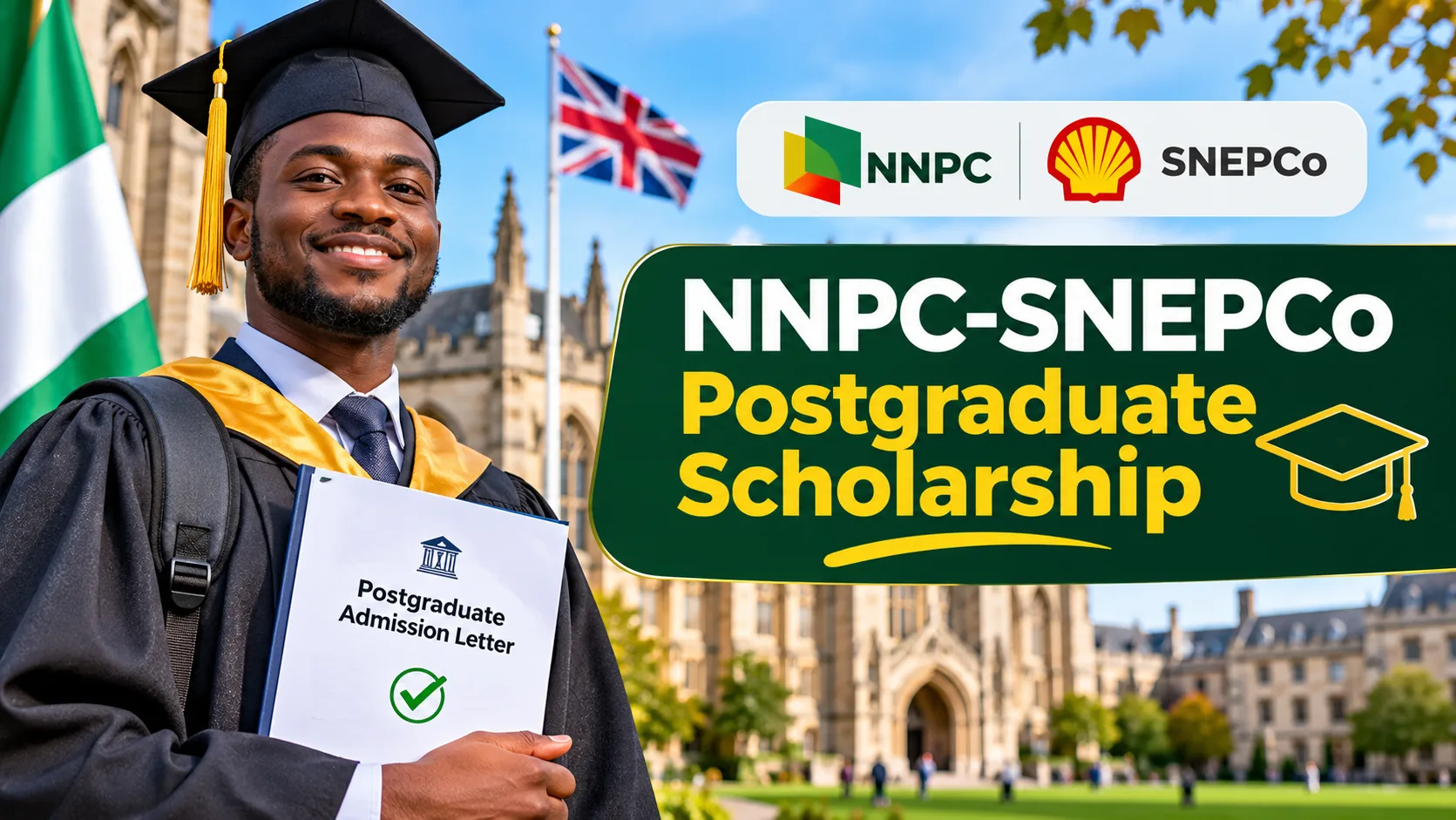
You should also explore individual opportunities such as the NNPC-SNEPCo Postgraduate Scholarship, which provides another route for eligible Nigerian graduates interested in postgraduate study in the United Kingdom.
Remember that scholarship requirements and funding arrangements can change. Always confirm the latest information directly with the organisation offering the award before applying.




Discussion
No comments yet
Be the first to share your thoughts, analysis, or questions on this story.
Report Comment
Help our editorial moderation team keep discussions constructive and factual.