




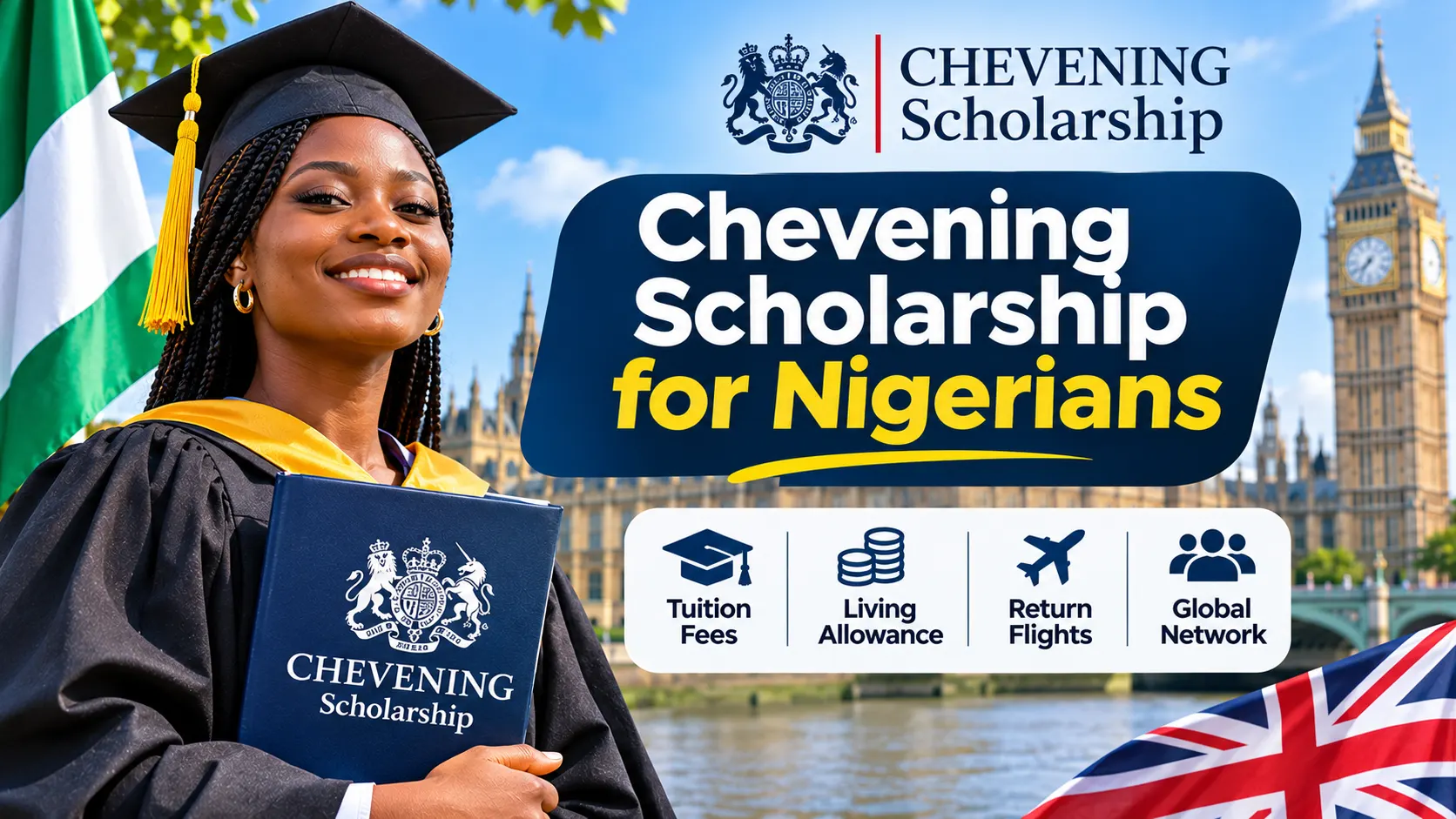
The Chevening Scholarship gives Nigerian professionals an opportunity to pursue a one-year master's degree at a university in the United Kingdom with financial support from the UK Government.
For graduates who have the academic qualifications, professional experience and ambition to make a difference in their communities, it is one of the most valuable international postgraduate scholarship opportunities to explore.
Unlike scholarships that focus mainly on academic results, Chevening also looks at leadership, professional relationships, career direction and the applicant's potential to contribute to positive change.
The scholarship covers approved tuition fees, living expenses, return travel and other specified costs. Successful applicants also become part of an international network of scholars and alumni.
This guide explains the eligibility requirements, scholarship benefits, application process and what Nigerian graduates should prepare before applying.
Is the Chevening Scholarship Open to Nigerians?
Yes. Nigeria is one of the countries participating in the Chevening Scholarship programme.
However, applications are not open throughout the year. Chevening operates specific application cycles, and interested candidates must submit their applications within the published application window.
Latest application update: As of November 26, 2026, applications for the 2027–2028 Chevening Scholarship cycle are closed. The next application cycle has not yet been officially announced.
For Nigerians who submitted applications for the 2027–2028 cycle, the selection process continues into 2027. Chevening's published timeline includes shortlisting in February, interviews between March and April, and results from mid-June.
If you missed the application window, you can begin preparing for the next cycle rather than waiting until applications open.
Check the official Nigeria scholarship page for announcements:
https://www.chevening.org/scholarship/nigeria/
What Is the Chevening Scholarship?
Chevening is the UK Government's international scholarship programme, funded by the Foreign, Commonwealth and Development Office (FCDO) and partner organisations.
It was established to support outstanding individuals who demonstrate the potential to become influential leaders and contribute to positive change in their countries.
The programme gives selected applicants the opportunity to study for a one-year taught master's degree at an eligible UK university.
Beyond the academic qualification, Chevening places considerable emphasis on building relationships, developing leadership abilities and creating a network of professionals who can work together to address shared challenges.
For Nigerian scholars, this provides an opportunity to gain international academic exposure while developing skills and relationships that can be applied to professional and community development at home.
What Does the Chevening Scholarship Cover?
One of the main reasons Chevening attracts applications from Nigerian graduates is its financial support.
The standard Chevening award includes several benefits designed to support scholars during their studies in the United Kingdom.
1. Full University Tuition Fees
Chevening covers approved tuition fees for the eligible master's programme.
This means successful scholars do not have to fund the normal tuition cost of their approved course themselves, subject to the terms of their award.
Some partnership awards have specific arrangements, so applicants should always review their final award conditions.
2. Monthly Living Allowance
Successful scholars receive a monthly personal living allowance, commonly referred to as a stipend.
The allowance is intended to help cover accommodation and everyday living expenses while studying in the UK.
The amount depends on whether the scholar is studying in London or outside London. Rates are subject to periodic review.
3. Return Economy Flight
The scholarship includes economy-class travel to and from the scholar's country of residence through an approved travel route.
This benefit is provided for the scholar and should not be assumed to cover accompanying family members.
4. UK Visa Application Cost
Chevening covers the cost of the scholar's UK entry clearance visa application.
The programme also confirms that scholars do not need to pay the Immigration Health Surcharge under the applicable award arrangements.
5. Arrival Allowance
Successful scholars receive an arrival allowance to help with certain expenses when they arrive in the UK.
This is intended to support the transition into the study environment.
6. Departure Allowance
The programme also provides a departure allowance towards eligible expenses associated with leaving the UK at the end of the scholarship.
7. TB Test Contribution
Chevening provides a contribution of up to £75 towards tuberculosis testing where this is required.
8. Travel Top-Up Allowance
A travel top-up allowance is also included under the published award benefits.
The exact payment arrangements and conditions are explained in the scholarship documentation.
Important: Chevening benefits are subject to the official award terms. Applicants should not assume that the scholarship covers every personal expense, family travel, university deposits or unrelated costs.
You can confirm the current funding package through the official Chevening funding guidance:
https://www.chevening.org/faqs/what-does-a-chevening-scholarship-cover/
Who Is Eligible for the Chevening Scholarship in Nigeria?
The Chevening Scholarship is competitive, and applicants must meet specific eligibility conditions before they can be considered.
The following are the main requirements published by Chevening.
1. You Must Be a Citizen of an Eligible Country
Applicants must be citizens of a country or territory eligible for Chevening.
Nigeria is an eligible country.
For applicants from countries covered by the relevant development assistance rules, Chevening also has residency requirements. Check the country-specific guidance if you are living outside Nigeria.
2. You Must Have an Undergraduate Degree
You must hold an undergraduate qualification that allows you to gain admission to a postgraduate programme at a UK university.
Chevening requires applicants to have completed their undergraduate studies at least two years before the scholarship application deadline.
You must have your official degree certificate by the time of your Chevening interview.
There is no universal minimum degree classification stated in the general Chevening eligibility criteria. However, you must meet the academic entry requirements of your chosen UK universities.
3. You Must Have at Least 2,800 Hours of Work Experience
This is one of the most important requirements.
Applicants must have at least two years of eligible work experience, equivalent to 2,800 hours.
The experience must have been acquired after completing your undergraduate studies.
Chevening accepts several types of work experience, including:
Full-time employment.
Part-time employment.
Voluntary work.
Paid internships.
Unpaid internships.
This means you do not necessarily need to have worked in a traditional full-time office job to qualify.
However, you must accurately record your work history and ensure that your experience meets the programme's rules.
4. You Must Be Willing to Return to Your Home Country
Chevening scholars must agree to return to their country of award for at least two years after completing their scholarship.
For a Nigerian applicant, this means committing to return to Nigeria after completing the master's programme.
This is an important condition of accepting the award.
Chevening is intended to develop individuals who can use their education, skills and professional networks to contribute to their home countries.
5. You Must Apply to Three Eligible UK Master's Courses
Applicants must identify three different eligible master's courses at UK universities.
The courses should be relevant to your academic background, professional experience and future career plans.
You do not have to receive admission offers from all three universities before submitting your Chevening application.
However, you must secure an unconditional offer from at least one of your three selected courses by the deadline specified in the application timeline.
6. You Must Not Fall Under Chevening's Exclusion Categories
Certain applicants are not eligible for the scholarship.
These include people who:
Hold British or dual British citizenship, subject to the specific exceptions stated in Chevening's rules.
Are resident in the UK at the time of application, subject to the stated exceptions.
Have refugee status in a country that is not eligible for Chevening, subject to the programme's specified exceptions.
Are employees, certain immediate relatives of employees, or recently employed individuals covered by the programme's restrictions involving relevant UK government departments, the British Council and partner universities.
Have previously studied in the UK on a UK Government-funded scholarship, subject to the specific exception for former Chevening Fellowship recipients.
Having a master's degree already does not automatically disqualify you from applying for another master's degree through Chevening.
Read the full eligibility guidance before applying:
https://www.chevening.org/resource-hub/guidance/eligibility/
Is There an Age Limit for the Chevening Scholarship?
No. Chevening does not impose an upper age limit for scholarship applicants.
This means that Nigerian graduates who meet the other eligibility conditions can apply regardless of whether they are in their twenties, thirties or older.
What matters is whether you meet the academic, work experience, nationality and other programme requirements.
Do You Need IELTS for the Chevening Scholarship?
Chevening does not have its own English language test requirement. The programme removed this requirement in 2020.
However, this does not mean that you can automatically study at any UK university without proving your English proficiency.
Each university sets its own admission requirements.
Some universities may require IELTS, while others may accept alternative qualifications or evidence that your previous education was conducted in English.
Before selecting your courses, check the English language requirements of each university.
You can confirm Chevening's position here:
https://www.chevening.org/faqs/what-happened-to-chevenings-english-language-requirement/
Which Courses Can You Study Through Chevening?
Chevening scholarships generally support one-year, full-time, taught master's degree programmes in the United Kingdom.
Applicants can select courses across many academic disciplines, including:
Business and management.
Economics and finance.
Public policy.
International relations.
Engineering.
Technology and computer science.
Public health.
Environmental science.
Education.
Development studies.
Law and governance.
Energy and sustainability.
However, not every postgraduate course is eligible.
According to Chevening's course guidance, eligible courses must generally:
Be full-time.
Start in the autumn term, usually September or October.
Lead to a master's degree.
Last between nine and twelve months.
The programme does not generally fund distance-learning courses, part-time courses, January-starting courses, research-based master's programmes or courses outside the permitted duration.
You should use the official Chevening course finder to confirm that your preferred programmes are eligible.
https://www.chevening.org/scholarships/find-a-course/
How to Apply for the Chevening Scholarship in Nigeria
Applications must be submitted through Chevening's official online application system during the application window.
The process involves more than filling out a form. You need to understand the eligibility criteria, select suitable courses and prepare strong responses to the scholarship's application questions.
Here is how the process works.
Step 1: Confirm Your Eligibility
Before starting an application, review the official eligibility requirements.
Check that:
You are a Nigerian citizen.
You have completed an eligible undergraduate degree.
You have at least 2,800 hours of qualifying post-graduation work experience.
You can meet the two-year return requirement.
You can identify three eligible UK master's courses.
You do not fall under any exclusion category.
You can also use Chevening's official eligibility guidance to assess your position.
Step 2: Research Your Three Preferred Courses
Choose three eligible UK master's programmes that support your career plans.
Do not select courses simply because they are offered by popular universities.
Think about what you want to achieve professionally and how each course will help you get there.
For example, a Nigerian professional working in public administration may consider courses in public policy, governance or development management.
Someone working in technology may explore courses in artificial intelligence, cybersecurity, data science or technology management.
Your course choices should demonstrate a clear academic and professional direction.
Step 3: Prepare Your Application Information
Before registering, organise the information you will need.
This includes:
Personal details.
Education history.
Work experience history.
Details of your three selected courses.
Contact details for two referees.
Responses to the four Chevening essay questions.
Make sure your work experience records are accurate, especially the dates and hours worked.
Step 4: Register on the Official Application Portal
When applications open, visit the official Chevening page for Nigeria.
Follow the application link to the online system.
You will be asked to register your email address and mobile phone number.
After completing the initial registration, Chevening will send you a link to continue your application.
Step 5: Complete the Eligibility Checker
The application system will ask questions to establish whether you meet the scholarship's eligibility conditions.
Answer every question accurately.
If you pass the eligibility checker, you will receive instructions for continuing your application.
Step 6: Save Your Unique Access Code
After passing the eligibility check, the application system will provide a unique access code.
Keep this code somewhere secure.
You will need it to access your application again.
It is also advisable to save the registration email and keep your account details accessible.
Step 7: Complete the Application Form
The application form includes sections covering:
Personal information.
Immigration and nationality details.
Education history.
Work experience.
Three selected UK master's courses.
Two referees.
Scholarship essay questions.
Equal opportunities information.
Complete each section carefully and save your progress regularly.
Chevening's application system may log you out after a period of inactivity, so avoid leaving an unfinished application open without saving.
Step 8: Submit Your Application
Before submitting, review every section.
Check that:
Your personal information is correct.
Your work experience meets the required hours.
Your three courses are eligible.
Your referees' details are accurate.
Your essay responses answer the questions.
Every required section is complete.
Once submitted, you cannot simply edit the application yourself.
Chevening confirms successful submission through its online system and email notification.
Official application guidance:
https://www.chevening.org/resource-hub/guidance/online-application-system/
The Four Chevening Essay Questions
The essay section is one of the most important parts of the application.
Chevening asks applicants to demonstrate their abilities and potential across four main areas.
1. Leadership and Influencing
You need to demonstrate that you can lead people, influence decisions or bring about positive change.
You do not necessarily need to have held a senior management position.
Examples could include:
Leading a project at work.
Organising a community initiative.
Helping an organisation improve its operations.
Coordinating a team to solve a problem.
Influencing a decision that produced measurable results.
Focus on what you personally did and the outcome of your actions.
2. Relationship Building and Professional Networking
Chevening wants to understand how you build professional relationships and use collaboration to achieve meaningful results.
You may discuss situations where you:
Built relationships with important stakeholders.
Worked with different organisations.
Connected people to achieve a shared goal.
Developed partnerships that produced measurable outcomes.
Used professional networks to solve a problem.
Explain the role you played and why the relationships mattered.
3. Your Course Choices
You must demonstrate that you have researched your three selected UK master's courses.
Explain why you selected them and how your first-choice course connects to your academic background, professional experience and future ambitions.
Chevening expects applicants to understand the specific modules and learning opportunities that will help them achieve their goals.
Avoid giving generic reasons for choosing a university.
4. Your Career Plan and Future Goals
This question focuses on what you intend to do after completing your studies.
You should present a realistic career plan with short-term, medium-term and long-term goals.
Explain how the knowledge and professional relationships you gain in the UK will help you contribute to your home country.
Your plan should be specific and achievable rather than simply stating that you want to become successful.
Important application integrity warning: Chevening explicitly prohibits applicants from using AI software to generate answers to its essay questions. It also warns that applications are screened for plagiarism and AI-generated content. Applicants must write their own original responses. Do not submit AI-generated essays as your personal work.
Official application criteria:
https://www.chevening.org/resource-hub/guidance/application-criteria/
What Documents Do You Need for a Chevening Scholarship?
Chevening does not require applicants to upload all their supporting documents when initially submitting the application.
However, candidates who progress to the interview stage must provide the required documentation.
Documents requested at that stage include:
Valid photo identification.
Official undergraduate degree certificate or diploma.
Two reference letters.
Other documents requested by the scholarship team.
You should prepare these documents early rather than waiting until you receive an interview invitation.
Your referees should be people who know your academic or professional abilities well enough to provide meaningful references.
Chevening also requires references to be written in English. References in other languages must be officially translated and notarised according to its instructions.
How Does the Chevening Selection Process Work?
Submitting an application does not guarantee an interview or scholarship award.
Chevening uses a competitive selection process.
The process generally involves the following stages:
1. Eligibility screening
Applications are checked against the programme's eligibility requirements.
2. Application assessment
Eligible applications are reviewed by independent reading committees.
3. Interview shortlisting
Successful candidates are shortlisted and invited to interview through the relevant British embassy or high commission.
4. Interview
Candidates are interviewed by a panel that assesses their leadership, professional experience, course choices and career plans.
5. Final selection
Candidates are informed of the outcome following the interview process.
6. University offer verification
Successful candidates must meet the programme's university offer requirements and submit the required unconditional offer by the specified deadline.
The scholarship is highly competitive, so applicants should not assume that meeting the minimum requirements guarantees selection.
Chevening Scholarship Application Timeline
Chevening publishes a timeline for each application cycle.
The dates below are the official timeline for the 2027–2028 scholarship cycle, which is currently closed to new applications.
| Selection stage | 2027–2028 cycle |
|---|---|
| Applications opened | August 2026 |
| Applications closed | October 2026 |
| Eligibility screening | From October 2026 |
| Reading committee assessment | October 2026 – January 2027 |
| Interview shortlisting | Mid-February 2027 |
| Interviews | March – April 2027 |
| Results | From mid-June 2027 |
| Unconditional university offer deadline | 8 July 2027 |
| Studies begin | September/October 2027 |
The next application cycle's opening and closing dates have not yet been announced.
Do not assume that the next cycle will use exactly the same dates. Check the official timeline whenever Chevening publishes a new application notice.
Official timeline:
https://www.chevening.org/scholarships/application-timeline/
How to Improve Your Chances of Winning the Chevening Scholarship
Chevening receives applications from talented professionals across the world. A strong academic background is useful, but your application must also demonstrate leadership potential and a clear professional direction.
Here are some practical ways to strengthen your application.
Demonstrate Real Leadership Experience
Think about situations where you took responsibility, solved problems or influenced others.
Leadership can happen in a workplace, business, professional association or community.
Use examples that show what you did and the results you achieved.
Keep Records of Your Work Experience
Since Chevening requires 2,800 hours of eligible experience, maintain accurate records of your employment, internships and voluntary activities.
Record your start and end dates and the hours you worked.
Do not exaggerate your experience to meet the requirement.
Choose Courses That Support Your Career Direction
Your selected courses should have a clear relationship with your professional goals.
If you want to work in public policy, for example, selecting three unrelated programmes may make your career direction difficult to understand.
Research the universities, course modules and skills you expect to gain.
Build Professional Relationships
Chevening values applicants who can establish meaningful professional relationships.
Think about how you have collaborated with colleagues, clients, community organisations or industry stakeholders to achieve results.
Explain the value of those relationships rather than simply listing people you know.
Develop a Realistic Career Plan
Your career plan should explain what you want to achieve after your studies.
Think about the professional challenges you want to address in Nigeria and how the master's degree will help you contribute.
Avoid making promises that are unrealistic or disconnected from your experience.
Give Yourself Enough Preparation Time
Do not wait until the application window opens before researching universities and collecting documents.
Preparing early gives you time to understand the requirements, select suitable courses and organise your references.
Is the Chevening Scholarship Free to Apply For?
Yes. Applying for a Chevening Scholarship is free.
Chevening explicitly states that applicants do not need to pay anyone to submit an application.
The programme does not endorse third parties that charge applicants for scholarship application support or guaranteed selection.
Be careful with individuals who claim to have connections inside Chevening or the British High Commission and promise to secure an award in exchange for money.
You may encounter legitimate university application charges or other independently required expenses, but these should be confirmed directly with the relevant institution.
Can You Work in the UK After Receiving a Chevening Scholarship?
Chevening scholars are required to return to their country of award for at least two years immediately after completing their scholarship.
For Nigerian scholars, this means returning to Nigeria and fulfilling the two-year return commitment.
Chevening's award conditions also prevent scholars from using the Graduate Route visa to remain in the UK immediately after their course.
This is an important consideration for anyone whose main objective is to study in the UK and remain there permanently.
Chevening is designed to develop leaders who return home and use their knowledge and experience to create positive change.
1. Is the Chevening Scholarship open to Nigerians?
Yes. Nigeria is a participating country in the Chevening Scholarship programme. However, applications are accepted only during the official application window.
2. Is the Chevening Scholarship fully funded?
Yes. The standard award covers approved tuition fees, economy return travel, a monthly living allowance, an arrival allowance, a departure allowance, the applicable visa application cost and other specified benefits.
3. How many years of work experience do I need?
You need at least 2,800 hours of eligible work experience acquired after completing your undergraduate degree. This is equivalent to approximately two years of full-time work.
4. Can I apply for Chevening without work experience?
No. Applicants must meet the 2,800-hour work experience requirement. Eligible experience can include full-time employment, part-time employment, voluntary work and paid or unpaid internships.
5. Is there an age limit for the Chevening Scholarship?
No. Chevening does not have an upper age limit. Applicants must meet the other eligibility conditions.
6. Can I apply with a Second Class Lower degree?
Chevening's general eligibility requirement is that your undergraduate degree must qualify you for admission to a UK master's programme. The university you select determines whether your degree classification meets its admission requirements.
7. Do I need IELTS for Chevening?
Chevening itself does not require IELTS or another specific English language test. However, your selected UK university may require an English language qualification as part of its admission process.
8. Can I apply for Chevening if I already have a master's degree?
Yes. Having an existing master's degree does not automatically disqualify you from applying for another master's degree through Chevening. You must still meet the programme's eligibility requirements and the admission conditions of your chosen universities.
9. Do I need admission before applying for Chevening?
No. You can submit your Chevening application before receiving admission offers. However, you must identify three eligible UK master's courses and obtain an unconditional offer from at least one by the deadline specified in the application timeline.
10. Can I apply to more than three universities?
The Chevening application requires you to identify three eligible UK master's courses. You can apply separately to universities according to their admission procedures, but your scholarship application must follow Chevening's three-course requirement.
11. Can I stay in the UK after completing my Chevening Scholarship?
Chevening scholars must return to their country of award for at least two years after completing the scholarship. The programme does not allow scholars to use the Graduate Route visa immediately after their award.
12. When will the next Chevening application open?
The next application window has not yet been officially announced. Check the Chevening Nigeria page and the official application timeline for updates.
Final Thoughts
The Chevening Scholarship is an opportunity for Nigerian graduates and professionals who want to develop their expertise, gain international exposure and build relationships with future leaders from around the world.
However, getting selected requires more than having a good university degree. You must demonstrate professional experience, leadership, the ability to build meaningful relationships and a realistic plan for creating positive change after your studies.
If you meet the eligibility requirements, start preparing early. Research your preferred universities, organise your work experience records, identify suitable referees and develop a clear understanding of your career goals.
Most importantly, use the official Chevening website for application information and write your own original scholarship responses.
You can also explore our guide to fully funded master's scholarships for Nigerians for other postgraduate funding opportunities in the UK, Europe and beyond.




Discussion
No comments yet
Be the first to share your thoughts, analysis, or questions on this story.
Report Comment
Help our editorial moderation team keep discussions constructive and factual.