



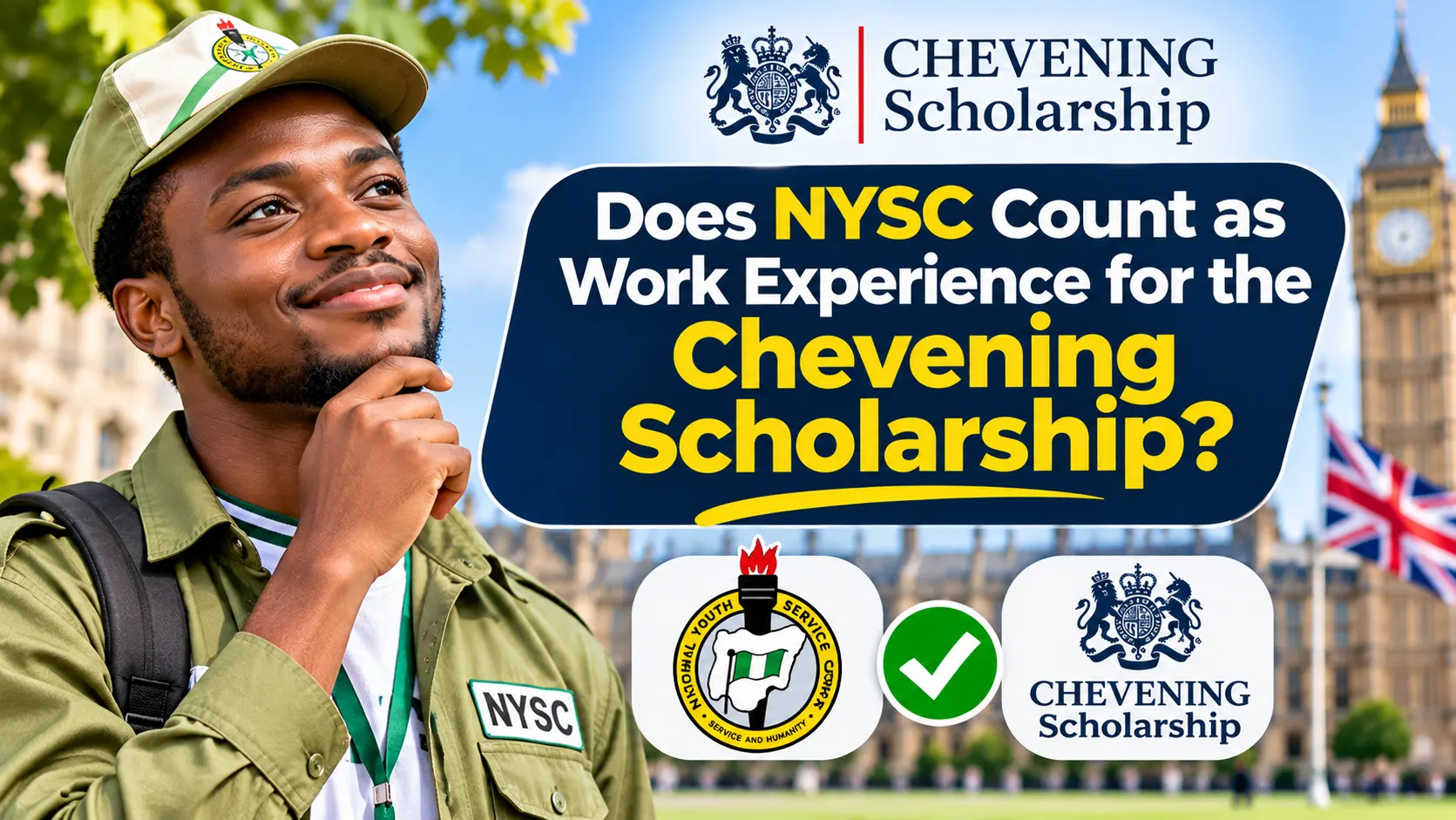
Does NYSC Count as Work Experience for the Chevening Scholarship?
If you are a Nigerian graduate planning to apply for the Chevening Scholarship, you may be wondering whether your National Youth Service Corps (NYSC) year can help you meet the scholarship's work experience requirement.
It is an important question because Chevening requires applicants to have at least 2,800 hours of qualifying work experience, and many Nigerian graduates spend approximately one year serving in organisations through the NYSC programme.
The short answer is that your NYSC experience may be relevant, but completing NYSC does not automatically mean you have met Chevening's work experience requirement. The nature of your duties, the hours you worked, when you completed your degree and whether your experience meets Chevening's criteria all matter.
This guide explains what Nigerian applicants should understand before including NYSC in their Chevening applications.
Does NYSC Count as Work Experience for Chevening?
Chevening does not specifically identify the National Youth Service Corps as an automatically accepted category of work experience.
However, its official guidance recognises several types of qualifying experience:
Full-time employment
Part-time employment
Voluntary work
Paid internships
Unpaid internships
Chevening requires this experience to be acquired after completing your undergraduate degree. Its current work experience guidance also specifies a minimum period of two years, alongside the 2,800-hour requirement.
This means that an NYSC placement could potentially contribute to your qualifying experience if the actual work you performed fits an accepted category.
For example, a corps member deployed to a company, school, government agency or nonprofit organisation may perform regular professional duties, support projects, assist with operations or take on responsibilities similar to those of an employee.
Those activities may be relevant when assessing the experience. However, you should not assume that every NYSC placement automatically qualifies simply because you received a posting letter and completed your service year.
The safest approach is to assess the actual duties you performed against Chevening's published requirements.
You can read the official guidance here: https://www.chevening.org/scholarships/who-can-apply/work-experience/
What Does Chevening Require for Work Experience?
Before deciding whether your NYSC experience qualifies, you need to understand the basic requirement.
Chevening requires applicants to have:
At least 2,800 hours of qualifying work experience.
Experience acquired after completing an undergraduate degree.
At least two years of work experience under its current published guidance.
Chevening describes 2,800 hours as approximately two years of full-time work, using a 35-hour working week.
It accepts different forms of employment and work experience, meaning you do not necessarily need to have worked in a conventional full-time office job.
For instance, qualifying experience could come from a combination of full-time employment, part-time work, voluntary work and internships.
You can also enter up to 15 different employment periods in your application to meet the required hours.
However, the experience must be genuine, accurately reported and consistent with the eligibility rules.
Source: https://www.chevening.org/scholarships/who-can-apply/work-experience/
When Can Your NYSC Experience Be Relevant?
Your NYSC placement may be relevant if you performed actual work responsibilities in your Place of Primary Assignment (PPA).
Consider the following examples.
1. NYSC members working in private companies
Suppose you studied computer science and were posted to a technology company in Lagos.
During your service year, you worked with the technical team, assisted with software development, maintained company systems and participated in projects.
These responsibilities could provide relevant professional experience.
The important consideration is not simply that you were an NYSC member. It is the work you actually performed, the period you performed it and whether it meets Chevening's accepted work experience categories.
2. NYSC members working in government agencies
A graduate posted to a government ministry, department or agency may perform administrative, research, communication, finance or project-related duties.
For example, an NYSC member working in a government department might assist with data management, prepare reports, support public programmes or coordinate administrative activities.
Such responsibilities may be relevant when assessing work experience, provided they meet the applicable criteria.
3. NYSC members working with NGOs
Some corps members are posted to nonprofit organisations and development-focused institutions.
Their responsibilities may include community development, project coordination, education programmes, public health awareness, research and administration.
Chevening recognises voluntary work as an eligible category of experience. Therefore, genuine responsibilities undertaken in an NGO or community organisation may be worth considering.
However, do not assume that every activity performed during NYSC automatically qualifies as voluntary work. The actual nature of the work matters.
4. NYSC members working as teachers
Graduates posted to schools may gain experience through classroom teaching, lesson preparation, student assessment, educational support and other school responsibilities.
These activities may be relevant when assessing professional or voluntary work experience.
If you served as a teacher during NYSC, document your responsibilities and the period you performed them.
Important: These examples are not official Chevening confirmations that specific NYSC placements qualify. Chevening does not publish a blanket rule approving all NYSC service. Applicants should assess their individual circumstances against the official criteria.
Does the Entire NYSC Service Year Count as Work Experience?
Not necessarily.
You should not automatically enter 12 months of NYSC service as 12 months of qualifying full-time employment.
Chevening calculates work experience using the number of weeks worked and the number of hours worked per week.
For example, if you worked 35 hours every week for 40 weeks, your calculation would be:
35 hours × 40 weeks = 1,400 hours.
That is only an illustration of the calculation, not an automatic allocation of 1,400 hours to every NYSC participant.
Your actual working arrangement matters.
Consider these questions:
How many weeks did you actually work?
How many hours did you work each week?
Were you carrying out genuine professional, voluntary or internship responsibilities?
Did your experience begin after completing your undergraduate degree?
Can you accurately explain what you did and who supervised your work?
If you spent some periods away from your PPA, were not performing duties or worked fewer hours than a conventional full-time employee, you should reflect that accurately.
Do not inflate your working hours to reach the required number.
Can You Combine NYSC with Other Work Experience?
Yes. Chevening allows applicants to combine different eligible employment periods to meet the work experience requirement.
This can be particularly useful for Nigerian graduates who have worked in different organisations or employment arrangements.
For example, you may have:
Completed an NYSC placement where you performed qualifying duties.
Worked part-time for a business after graduation.
Completed a paid or unpaid internship.
Undertaken qualifying voluntary work.
Worked full-time for a private company.
These experiences may be combined where they meet Chevening's eligibility rules.
However, remember that the current requirement includes both the minimum 2,800 hours and the minimum two-year period. Reaching 2,800 hours alone should not be treated as proof that you meet every part of the requirement.
You should also avoid entering overlapping employment periods in a way that counts the same hours twice.
For example, if you worked part-time for a company while serving at your PPA, you must report the actual hours for each role without double-counting the same working time.
Does Work Experience Before Graduation Count?
This is an important distinction for students who worked or completed internships while studying at a Nigerian university.
Chevening's current published work experience guidance states that qualifying experience must be acquired after completing your undergraduate degree.
Therefore, you should not rely on employment, internships or voluntary activities undertaken before completing your undergraduate degree to satisfy the current 2,800-hour requirement.
For example, if you completed an internship in your third year at university and subsequently completed NYSC after graduation, the internship should not be assumed to count towards the current requirement.
You should also distinguish between completing your university examinations and officially completing your undergraduate studies. Chevening's eligibility rules use the completion of undergraduate studies as the relevant reference point.
Read the official eligibility requirements before applying: https://www.chevening.org/resource-hub/guidance/eligibility/
What Evidence Should You Keep for Your NYSC Experience?
Chevening asks applicants to provide employment details in the application form, including employer names, job titles and employment dates.
If your application progresses to the interview stage, you will be asked to provide references, which may be verified by the British embassy or high commission.
Although you are not required to upload proof of every employment period with your initial application, keeping accurate records can help you explain your experience when asked.
For your NYSC placement, consider keeping the following:
1. NYSC posting and deployment information
Keep copies of your NYSC posting letter and any documentation showing the organisation where you completed your primary assignment.
2. PPA confirmation or service records
Where available, retain documents confirming your placement, service dates and responsibilities.
3. Details of your actual job responsibilities
Write down the duties you performed, projects you supported, teams you worked with and any measurable contributions you made.
4. Supervisor or employer contact information
Keep the contact details of someone who can confirm your work and responsibilities if Chevening requests a reference.
5. Accurate working hours and dates
Record your actual working schedule and employment dates. These details will help you calculate your qualifying experience accurately.
These are practical record-keeping recommendations, not a list of documents Chevening requires every applicant to upload.
Official guidance: https://www.chevening.org/faqs/do-i-need-to-submit-proof-of-my-work-experience/
What If Your NYSC Year Is Not Enough to Meet the Requirement?
If your NYSC experience is relevant but does not provide enough qualifying hours or the required period, you may need additional work experience before applying.
You do not necessarily need to work for one employer or remain in the same industry.
Depending on the nature of the work, you could build additional experience through:
Full-time employment after NYSC.
Part-time professional work.
Paid or unpaid internships.
Voluntary work with legitimate organisations.
Freelancing or self-employment where the work genuinely meets the applicable criteria.
For example, a graduate who completes NYSC and subsequently works for a technology company may be able to combine qualifying experience from both periods.
The important thing is to meet the full eligibility requirement before submitting your application.
If you are not yet eligible, waiting for another application cycle is better than submitting an application with experience that does not meet the rules.
Other Chevening Eligibility Requirements Nigerian Applicants Should Know
Work experience is only one part of the Chevening Scholarship eligibility criteria.
Nigerian applicants must also satisfy the other requirements.
These include:
Nigerian citizenship: You must be a citizen of a Chevening-eligible country, such as Nigeria, and apply under the appropriate country award.
Undergraduate degree: You must hold an undergraduate qualification that meets the entry requirements for your chosen UK master's programme.
Graduation date: Under the current eligibility rules, applicants must have completed their undergraduate studies at least two years before the application deadline. Check the specific deadline for the cycle you intend to apply for.
Three eligible UK courses: You must apply for three eligible master's courses in the UK.
Unconditional university offer: You must secure at least one unconditional offer from your selected courses by the applicable deadline.
Return commitment: You must agree to return to your home country for at least two years after your scholarship ends.
Meeting the work experience requirement does not guarantee selection. Your application must also demonstrate your leadership potential, networking ability, career goals and the impact you intend to make.
You can review the full eligibility criteria on Chevening's official website: https://www.chevening.org/resource-hub/guidance/eligibility/
Is the Chevening Scholarship Open for 2027–2028?
As of November 2026, applications for the 2027–2028 Chevening Scholarship cycle have closed.
Nigerian applicants interested in a future cycle should monitor the official Chevening Nigeria page for announcements about the next application window and any updated eligibility requirements.
Do not assume that the dates or eligibility rules from one cycle will remain unchanged in the next.
Official Nigeria scholarship page: https://www.chevening.org/scholarship/nigeria/
1. Does NYSC automatically count as work experience for Chevening?
No. Chevening does not specifically state that every NYSC placement automatically qualifies. Your actual responsibilities must be assessed against its accepted work experience categories and eligibility rules.
2. Can I use my NYSC PPA experience for Chevening?
It may be relevant if you performed genuine work responsibilities that fit Chevening's accepted categories. You should accurately document your duties, dates and working hours and avoid assuming that the entire service year automatically qualifies.
3. Does NYSC count as voluntary work?
Not automatically. Chevening accepts voluntary work, but it does not specifically classify all NYSC placements as voluntary work. The actual activities and responsibilities matter.
4. Can I combine NYSC and full-time employment to reach 2,800 hours?
Yes, different qualifying employment periods can be combined. However, you must meet the full work experience requirement, including the minimum two-year period under the current published guidance.
5. Can my university internship count towards Chevening work experience?
Under Chevening's current published guidance, qualifying work experience must be acquired after completing your undergraduate degree. You should therefore not rely on internships completed before graduation to meet the current requirement.
6. Do I need an NYSC discharge certificate to apply for Chevening?
Chevening's published work experience guidance does not list an NYSC discharge certificate as a specific requirement for counting work experience. Its application asks for employment details, and shortlisted applicants may be asked to provide references. Check the full eligibility and application instructions for your intended cycle.
7. Can I apply for Chevening immediately after NYSC?
Completing NYSC does not automatically make you eligible. You must also meet the required work experience hours and minimum period, as well as the separate undergraduate completion-date requirement and all other eligibility conditions.
Final Advice for Nigerian Applicants
If you completed NYSC and want to apply for the Chevening Scholarship, do not dismiss your service experience, but do not assume it automatically qualifies either.
Look carefully at the work you performed during your placement. Calculate your actual working hours, identify the responsibilities you handled and keep records that can help you explain your experience.
If your NYSC placement does not provide enough qualifying experience, consider building additional experience through employment, internships or voluntary work after graduation.
Most importantly, use Chevening's official work experience guidance as your reference before submitting an application. A strong scholarship application begins with meeting the eligibility requirements honestly and accurately.



Discussion
No comments yet
Be the first to share your thoughts, analysis, or questions on this story.
Report Comment
Help our editorial moderation team keep discussions constructive and factual.